E182 - Why Great Cannabis Can Still Fail - Robert Rapozo & New Life Canna
https://reefermed.ca/component/k2/item/211-e182#sigProId8db4f55ea6
Research Links
Music By
Desiree Dorion
Marc Clement
(Yes we have a SOCAN membership to use these songs all legal and proper like)
Episode Transcript
Reefer MEDness_E182_NewLife.mp3
Trevor: Kirk, we're back.
Kirk: Hey Trevor how's it going.
Trevor: I am doing well as we're just sort of mentioning in the preamble this was CountryFest weekend just wrapped up so another another year another megastar named Jelly Roll comes swings through the town.
Kirk: I spent my time in Oanole watching the storms. This is storm time for our region and center of the continent. Anyways, I'm Kirk Nyquist. I'm the Registered Nurse and we are Reefer Medness - The Podcast.
Trevor: I'm Trevor Shewfelt, the Pharmacist and for this story you were a little farther west in and around the Edmonton area and this is going to be kind of a without you know giving up the spoilers. It's hard to make money if you are in the business of cannabis.
Kirk: You just gave away the punch line.
No, no, no. I think people should be... You know, like our guest said, you know, someone had slipped into his DMs and asked him, Hey, I want to grow cannabis, his first piece of advice. Don't do it.
Kirk: Don't do it. So this is this is a story that came from my road trip back in April. I took Van Hood out to the west coast and gathered some road stories as I went. And on my way home, I stopped in Edmonton to meet my cannabis nurse friend, Kala Knudslien. And she took me around. She took me around Edmonton and I met a bunch of her colleagues all within the cannabis field. And this is us visiting a company called New Life Cana Limited. And essentially this business, they're known as three or four firemen from Fort McMurray. I think it was initially three firemen from Fort McMurray wanted to do something different. And they started a cannabis business. Now I knew nothing of this, Trevor, when I was introduced to this gentleman. Kayla basically drove me around, pointed out some cannabis history in Edmonton, and we pulled into this industrial park. Next door there's a pickleball court and next door to that there's other industrial stuff. And basically you're going into these businesses and it's long narrow buildings and you go down a narrow driveway, you pull in front and non-descript doorway, you walk in and It's a long and narrow business within a building, growing cannabis. Now New Life has several businesses and this I didn't understand when I first walked in. And it didn't make sense to me until after I learned more about his business. So I'm going to tell the audience some things they need to know that'll make the conversation a little bit more interesting. Besides being a micro-cultivation, like cultivators,.
Trevor: Growing.
Kirk: They grow. They are Cultivators. Yes, they grew their own cannabis at a micro level. They got a micro license. New Life Canna Limited also has a micro packaging sales license. So in the conversation, we hear how they were getting cannabis from British Columbia, packaging that cannabis and sending it to Ontario. So they are they're not only growing cannabis They're also packaging cannabis for other growers, which I guess I want to talk about after the conversation as well.
Trevor: Sure,.
Kirk: So that's the introduction to the to the conversation
Trevor: Okay, so the gentleman you're talking to most of the time is Robert Raposo. Should we just let him introduce himself?
Kirk: Yeah, and also, thank you for that. And also, Kala's in this. So again, there's three voices, and you'll hear Kala in there at the end of the conversation as well. And yeah, so let's just go right into it and then come out and discuss what we learned about the cannabis business.
Trevor: All right.
Robert Raposo: My name is Rob. I'm one of the co-founders, owner, operator, wearing 15 hats of New Life Canna Limited. So we're based in Edmonton. We have a 6,000 square foot facility and our forward-facing brand is West Coast Gas and Holy Smokes. So, me and a couple other guys we're all career firefighter paramedics. We thought this would be a good idea in about 2020. So they'd previously been in the B.C. Housing market. They were building some houses. Sold at the wrong time, poor guys. And they had some business ideas and they were kind of asking me about the regulations and stuff. And it kind of just progressed from there. It was really interesting. Cause I had a coffee business. So Justin had actually said, hey, do you think that I could grow weed in the basement and then sell it on Etsy? Like legitimate question. We both were like, I don't know, like maybe you can. And obviously you can't. So the matches kind of went us down the road. And then like, I feel like a week or two later, Justin was looking at places in because he was in Calgary at the time, like acreage or rural properties, like, hey, can we build a farm here and can we do it? And we were looking at rezoning and then we went down the rabbit hole and I think at the we was still going for like over $3 a gram or so we believe, like we don't actually know, but so it's still a very viable business and it just launched us down this pathway that took us like I think two and a half years from inception to actually get a license.
Kirk: Did any of you grow before you opened it?
Robert Raposo: So one of us did.
Kirk: Okay.
Robert Raposo: Yeah. One of us had grown medic, sorry two of us, had grown medically but like nothing large scale.
Kirk: Right.
Robert Raposo: So there was some experience but then we met some guys who'd been growing for a very long time and that was really what actually allowed us to do this because like we at no point were thinking we were going to be growers and just banging out of the park but we were listening to the guys that had done it and the guys had helped us build our facility. Bloom. They guided us very heavily on what to do. And then we were able to take what they taught us and then through the people and just kind of be like, what's real, what's not, what works in our facility, what's bro science, what real? And then just kind have figured it all out and that's what we've done from the beginning.
Kirk: So out of the three partners, is one or two of them the growers now? Uh,.
Robert Raposo: So the way that it worked in the beginning...
Kirk: Who's the master grower? Yeah.
Robert Raposo: So, in the beginning, it was all of us switching hands. One of our guys was a master grower. We kind of would flip off, but we were like working shift on and shift off. So there's like one or two guys on and one or guys off. And then we would alternate and then the guys on days off would just take care of whatever. And so the way it progressed though is that we were able to actually get some people to help us trim. So it wasn't just me sitting there with my wife trimming for eight hours and like going blind. So then one of our trimmers, Ryan, showed some interest in cultivation. And then he is the master grower now. It was, you know, it was Chris and then it was Justin and now it's Ryan and he truly is in cultivation and then Jesse, who you just saw in there is our processing guy. So he does all of the packaging and the sorting and the curating of our wheat because like. You know, I am a lightweight, so I'm definitely not your best gage of all of the strains out there, whereas these guys are. So we bring a lot of our sampling in, and if it doesn't pass their tests, and again, it's subjective, so we, you know Jesse and Ryan have different tastes, so we take their opinion, and I have a couple people that I'm always giving stuff to, kind of have them classified, and then that allows us to kind of build the brand off of other people's weed, our weed, how we're curing it, all that.
Kirk: Okay, so you're growing on site, you're packaging on site and your west coast gas is your SKU, so how many strains, varietals, do you have under west coast?
Robert Raposo: So it's, we have pretty much all rotating and that's just because that's the only way that we can truly survive. And so what a rotating SKU is, is that it means that it's a certain percentage and a certain profile that it can kind of fit in. So like, for example, the Old School Fuel will only put Death Bubba, Rockstar, you know, the Old School stuff. Exotics is way more open. You can put a Grape Diamonds in, which, you know it was Jesse Strain that he came up with there and the LA Guava. You can a lot more stuff in it, but it's typical profile. So if someone goes to Exotics, They know the avenue they get.
Speaker 2 Okay.
Robert Raposo: But we are in BC, but it's not our weed in BC. We're buying it from BC growers and selling it for them because that's just what works.
Kirk: And so they send you the weed by bulk and then you package it here under your font or your packaging. So I noticed actually you have strains. So you do list the strain.
Robert Raposo: Absolutely.
Kirk: So when people, if someone says hey I like the West Coast Gas and I really enjoyed your last strain, they go there's a potential they could not get this strain back.
Robert Raposo: That's correct, yeah. Because, and actually, there's been even times where we had some grown, it was a, it was a Tropicana Mints. And so, only one store in BC got it, and it was limited run, and at the end of it, the genetics were killed here, and the genetics where killed in BC. It was never intentional, just started going woody, and we just, but it was really sad because a lot of people really liked it. Yeah. But it's just a one and done.
Kirk: Right.
Robert Raposo: It's done. And so the way that, so we have a bunch of genetics, and then the guys in BC that we're working with have some genetics as well. So it really depends. On what we're growing, but the market dictates, obviously. We like to have options, though. So yeah, so anyways, we're selling in BC under the direct delivery mark. Alberta, we are under the central. Alberta's been the hardest by far. And then Ontario, we under flow through. And what that means is basically, rather than stocking it, they put our stuff on sale for a week. And then on the Monday night, we have to have it delivered to the warehouse on Wednesday. So our partner, Lori in Ontario, is the only way that we can do that.
Kirk: Okay, yeah, but it's under West Coast Gas.
Robert Raposo: Yes correct, actually, West Coast Gas has taken off mostly in Ontario.
Kirk: Okay, Ontario, BC, and Alberta is where you sell.
Robert Raposo: And then we are in the process of getting into Manitoba. It's just been logistically frustrating
Kirk: Well, welcome to Manitoba, but New Life Cana, that's the umbrella.
Robert Raposo: Yeah, so New Life Canna Limited is technically the processor, so it's the license holder is what they call it in the industry. So we are probably going to go under the New Life brand at some point, especially medically. We were definitely thinking the New life brand. Something we're learning a lot too, is that a lot of people distinguish the brands more with the people in the process as opposed to the branding, because we're not quite in that big world of marketing where the brand is being pushed on you. The brand really is us, right? It's me, it's Jesse, it is Ryan, it it's Justin, it the people that are involved in it. Yeah. See you later, man and so when we're like finding that out, it really has kind of changed how we look at the branding and honestly, we we love what we do and we have a very craft very I mean hands-off approach because the bud really doesn't get touched but we love it. But the thing is there's a lot of other cultivators out there who are much like us, dying and not able to make it and and having like struggling to get to the market and there's lot of predatory people out there. So what we're trying to find is where can we find the win-wins. Where can we find the this guy needs to sell it and we need to buy it and and we both win That's all we really want.
Kirk: And its good weed.
Robert Raposo: Exactly. And that's the thing is that there is a lot of other cultivators are there growing absolutely banger weed so
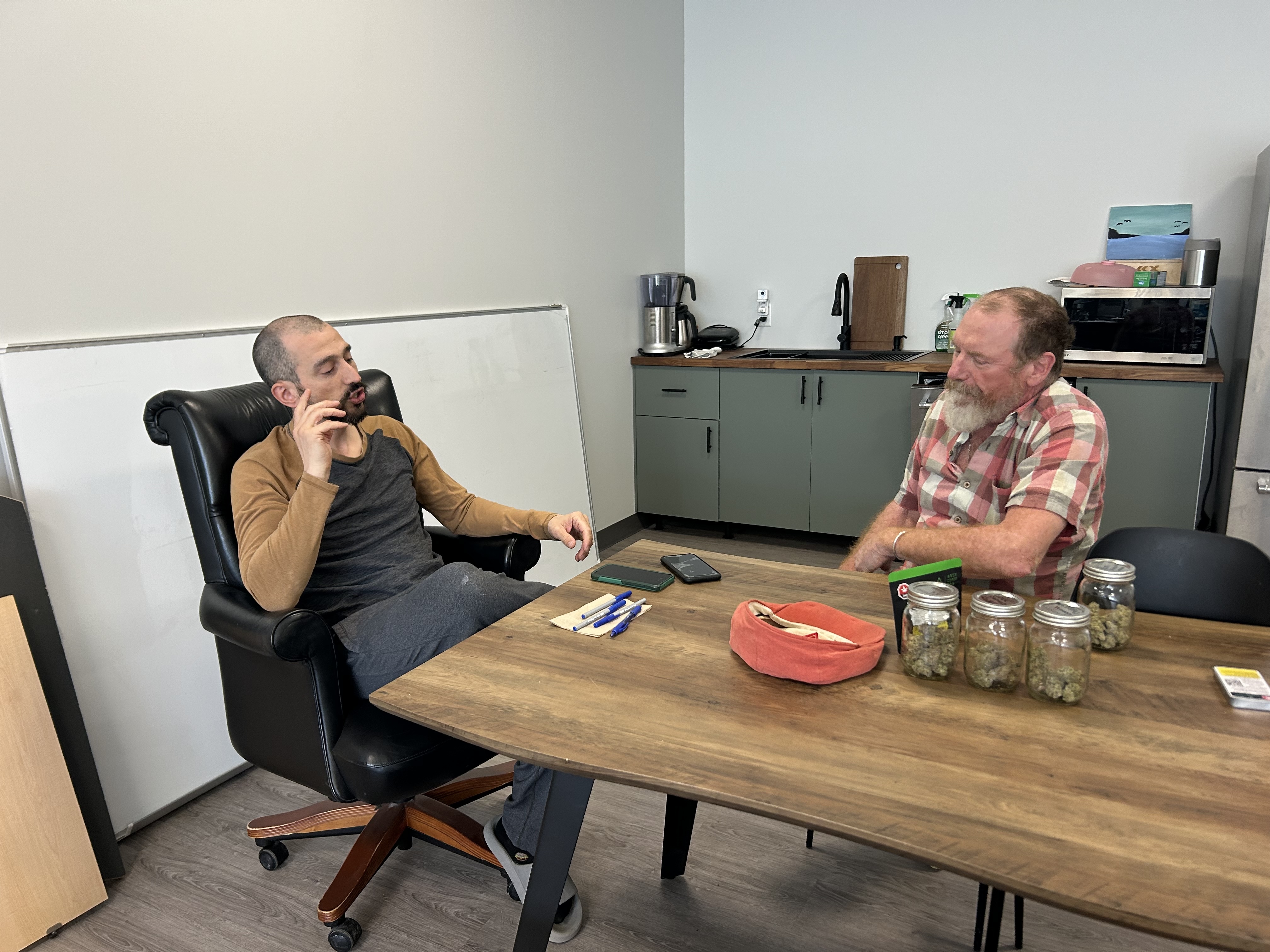
Kirk: Well, an example here, we're sitting, we are sitting at a table and there are four jars of cannabis buds and I don't think I've ever touched cannabis buds so dense, right? So these are all commercial weeds. This one, this one here, LA Grava, that's your, that yours.
Robert Raposo: Correct, yeah.
And this grape diamon.
Robert Raposo: Grape diamonds, yeah.
Kirk: The Great Diamonds, that is from...
Robert Raposo: That's our this particular one is ours, but we also both have these cultivars in BC as well.
Kirk: Okay But you grew this ones here?
Robert Raposo: These specific ones are ours, yeah.
Kirk: Wow.
Robert Raposo: Yeah,.
Kirk: It's just nice. And then these are the banana cheesecake. The banana cheesecake?
Robert Raposo: The banana cheesecake is is oddly enough from another firefighter from Vancouver Island is named Riley and he is killing it he is
Kirk: That is really amazing.
Robert Raposo: The smell, the nose on that one is unbelievable. And then the follow-up is cheese and people have been asking us for cheese. And so we tried to get some cheesy poops and none of them took off, but this was the cheese that we're bringing and we're gonna try and find the dirtiest cheese we can find and grow that next.
Kirk: So so then this this is this is sent to you by a couple kilos from BC
Robert Raposo: Yeah, so I think his final was just under four. And honestly, the fact that it finished this way, and I'll have to show you the COA. The COA is bonkers because not that we need to get into terpene testing yet, but a lot of terpene testing. So this one, the place he sent it, I believe only tests for 25 terpenes. Riley literally just picked a handful of buds, hucked it out, did a test, right? There was no doctoring, no nothing. This is his first time. And he got right out the gate of 30%. And then he got a three points something percent terpene, I can't remember, but it was like two and a half percent Myrcene. Yes.
Kirk: Myrcene that’s a lot.
Robert Raposo: I'll show you the, it is. It's crazy. And again. And again.
Kala Knudslien: This is a complete knockout.
Robert Raposo: So, and again, it is crazy because I see so many COAs now and you see the amount of stuff that's in it and the increased amounts and then what actually has percentages and what doesn't. And it is just so cool. And this is also living soil organic because he's on the island so clearly he's a hippie. And it has grown so naturally, so wonderfully on this farm. It's...
Kala Knudslien: But you can tell that. You can tell it looking and smelling it.
Robert Raposo: Yes, and then wait till you smoke it.
Kirk: So this then you'll package under the West Coast Gas under your rotating SKU.
Robert Raposo: Yes, in BC. So what has to happen.
Kirk: oh in British Columbia.
so I can sell this elsewhere, but the way that it works in BC, which gave us a bit of a delay, but because he was a new cultivator, so the cultivator has to register with BCLDB to be an approved cultivator for direct delivery because you can't be too big and you have to be registered. So once you're good there, then as long as you're selling their product, you can apply for SKUs and they don't gatekeep it. So BC is just like what SKU do you want? Yeah, we don't care because you're controlling it. They're not stocking it. So you want to ask for the most ludicrous SKU, like a 2.6 gram bag, like you can do that.
Kirk: Wow.
Robert Raposo: And then you just have to go through, like on our end, it's the same regardless, but we have the brand as West Coast Gas, but we could have put it as whatever else. We could have it as Emerald Farms, like that's his, that's cultivar name. Going out the gate, we put them under the West Coast Gas brand, but I can very much see us going under his brand because he's doing amazing things.
Kirk: Oh yeah.
Kala Knudslien: and a great story behind it.
Robert Raposo: Oh, it was the best. I mean, he literally slid into my DMs on Instagram and was like, hey man, I want to grow weed. And I was like don't do it. Like most firefighters, he didn't listen and so, you know, here we are with his banger ass weeds.
Kala Knudslien: And it's beautiful.
Kirk: and its amazing weed. So tell me a little bit about, I was in Hope and I went to Marlee's Den and the young lady there told me, she's been there forever, I've interviewed her before, she said in British Columbia the the government will sometimes just say we're not doing that SKU anymore.
Robert Raposo: Yes and so that's tip okay so in BC they have more options they have Farmgate, they have Direct Delivery, and they have Centralized Delivery. Really good model something we've been hinting at very much to AJLC I know they're looking at it because Direct Delivery allows me to go sell to directly to Spirit Leaf right like directly and you build that relationship. We don't have that here all we have is centralized warehouse. So in BC or Alberta if you're centralized warehouse, its great because you can put in big volumes. If you sell big volumes. They also pay you relatively quick be it 14 or 30 days I believe it's 14 for Alberta and Ontario but the problem with that is they control the SKU. So they tell you whether it's good or not and if they pay you and your stuff doesn't sell when it times out or it gets close to timing out which I think dried flour is nine months in both the provinces, they basically go here's your weed give me the money.
Kirk: Oh, wow,.
Robert Raposo: And if you paid excise on it you can get it refunded but you gotta, like typically people's cash flows aren't great. So when they get the weed and the weed's gone and they get money, they are trying to build their business.
Kala Knudslien: Especially for nine months.
Robert Raposo: Yeah, and then you get shitty old weed back and you can't sell.
Kirk: Yeah, yeah.
Robert Raposo: And then if you want to get... Anyway, so that is... And then they also control the SKUs, so they choose what works. So it's unfortunate because hearing some of the retailers at StratCan were saying like, hey, these five SKUs worked amazing and I was selling cases and cases of it, but they're not doing hundreds and hundreds because there may be a one or two or three store chain. So then to the government, they have certain metrics. And I know that BC and Alberta work off of metrics, but Ontario is insane. Ontario is like next-level metrics. They have everything and you basically are graded with a score. So you really have to like not have returns not have issues not have delivery problems or when you're applying for SKUs or trying to do other things you can't get them. So it's it's a whole other level but a lot of the times they do like the bottom percentage of whatever they choose gets delisted. So Ontario does it. Alberta does it and BC will do it. There's a little more leniency in Alberta. BC, I believe they have a cap on SKU, so they won't bring it anymore. So one has to drop off for one to come on. And they're very much BC promoting as well, which I don't blame them. I think it's a great thing. It just sucks when you're in Alberta cultivars.
Kirk: Where they just went through a strike, right?
Robert Raposo: Oh, the strike was pure chaos for us because we had direct delivery weed. So we were actually sitting on a bunch of BC weed that we weren't really selling all that well. And we were like, what are we going to do with this? Can we sell it in another province? What are we gonna do? We don't know. And when that strike happened, since these poor retailers have gone through this shit before, the guys that already knew what was happening were on the phone with us. And we we're working 24 hours a day trying to get out. But the problem is you're sending to each store.
Kirk: Right.
Robert Raposo: And then you have to invoice each one. So like, that's where centralized is great cause you give it to them. It's the whole centralized process is done. It goes out to whoever on there.
Kirk: But the centralized zone works for the big growers, right?
Robert Raposo: Not, it, I think it works more for big volume. Again, everyone's a little bit different, but like for us, central is okay. Direct delivery also is okay, but it's also really hard when you get the volume of what happened in the strike. But it was nice because like Adam from Microcraft, another guy that we grow with there, he's in Goldstream, he took a hit on his price and then we took a hit on our price and we were able to give it to retailers to fill one of the SKUs we already had because BC was closed so you couldn't get more SKUs. But if you had one you could sell it so we were able to actually fill because the value market nobody could get it because most of the direct delivery stuff is craft. Right. So it was crazy that the strike was insane but what happened after that like I think we did two hundred grand, in the month, but then basically didn't sell another gram of weed until like February into BC because it just, it messed up the market so much, but it was super cool to be a part of, to experience, but the poor fucking retailers, it was like trying to get like tickets at a concert event, like every they're calling up and we were trying our best to do it. And we fucked over a few of them, not intentionally, but it was just like getting all these orders in, and then you just take the first five guys and you do it, and you're like, oh my God, we're out of weed. What do we do? I promised it to seven people, and then they're like why didn't you send my weed? And they're dying on the other end because they need to keep their doors open. And so it was an interesting experience, but it really unfortunate because it shows how much power is in a body if they can shut down.
Kirk: Yeah, yeah.
Robert Raposo: And it was actually kind of scary. And we talked to the AGLC about it later. We said, well, what's gonna happen if Connect Logistics, who's the logistics provider for AGLCs does that? And they said, no, we have a few other things in place. They didn't go into great detail, but they said that that can't technically happen here because we have different process.
Kala Knudslien: Yeah, how a change like that can completely change the supply chain and then you your retailer and your person getting their medicine the grower The pretty everybody gets fucked over
Robert Raposo: And the really unfortunate part is we talked, so we met a lot of great people through the process, which was probably one of the benefits for it, and we could help a few things here and there, and it wasn't even that we made money because there was a lot of losses and learnings, and anyways, it was cool, but it was really sad to hear, especially people where they said, hey, there's a lot seniors around here, and they literally can't afford the craft stuff, and there's no value stuff left, so they can't get their medicine, they can get anything. So it was kind of sad to know that it could just affect. Like that. And then some of these poor retailers, too, like guys that hadn't been in business for a really long time, they didn't experience the last strike because they weren't quite prepared. So we had to onboard them. We had to do all the things. Whereas the other guys like, you know, Gary from Local and some other guys in BC, like they were on, they knew exactly what to do. The guys from THC had gone through it before. They were like on it. Like they were so calculated, but they must have some serious backup planning. But it sucks that you have to go to that far as to have another supply chain for your product, right?
Kirk: Well, I was thinking about the SKU thing, going back to the SKU thing, when a government says, well, we're going to cancel that SKU, they don't do that in Liquor industry.
Robert Raposo: no.
Kirk: Right, you can always get a Jameson's. They're not going to say all of a sudden, oh, Jameson, you, can't put that whiskey here anymore. So what is it about the cannabis?
Robert Raposo: I don't know and it is a very hard part about the centralized listing is that they are gatekeeping and it's really really shitty because, if I talk to retailer like let's just use Spirit Leaf again, right? If Spirit Leaf Sherwood Park tells me I have this super niche thing. You guys have it. Could we sell it? It would really work for both of us. I can't do that because on the volume scale, it won't work, so AGLC won't give me the list. And then I can just go drop it off at its house and again, just go to drop it of the store. It needs to be in the system. It needs be excised. It needs have all those regulatory things, which really sucks because I know people get mad when you talk about cannabis as CPG. I think it's CPG, I think its regulated CPG but it's like very close to consumer packaged goods. And sorry, yeah. And... But if you go to the grocery store, so I'll use my coffee company, for example, when I was in Sobe's, it was just like, hey, what do you wanna sell? And I was like, I wanna sell these. And they're like, cool, here's your SKUs. And you get it and you sell it. And then you're like hey, this one isn't working as well. I don't want that, but I wanna add another one. They're like sure.
Kala Knudslien: So you have that relationship.
Robert Raposo: You have the relationship, you have the freedom. They weren't really gatekeeping. They would suggest, hey, this is too high priced or this could sell better, but they didn't gatekeep because when I wanted to come up with a seasonal offering, they were like, oh, we don't like seasonal offering because if they don't sell, then we sit on the product. And I was like, oh, well, I'll only just bring in like a case a week then and they're like, okay, cool. And they were basically like, if you think it'll work, we'll sign on for it, right?
Kala Knudslien: You could get creative.
Robert Raposo: You can do what most brands need to do. And this came up yesterday in StratCan as well.
Kirk: And you're growing your brand.
Robert Raposo: And you're growing the retailer's brand, right? And that's the thing is that it's really hard because it's so disjointed that it is really hard for anyone to grow and then the cash flows all over the place and you can't really do the seasonal offerings because, for example, HLC is short in the window but it still takes a couple months to do it. So right now we're applying for the fall, the winter SKUs, the Christmas SKUs. So unless we have our shit in order now and know what I can get down the pipe. Really really hard to make work and then the retailer also has to know when it's gonna drop have the cash flow to be able to do it and in Alberta it's interesting if you put say 200 cases on the board but 300 people order it. Like nobody actually knows what they're gonna get because it goes to a lottery system and then some retailers don't actually get it and I believe If they don't get it, they don t get anything in space of that order. You can't just go back and be like, Oh, I'm going to fill it in with, you know, with sugar stuff or with somebody else's stuff. They can't do that. So it really is kind of a gamble for a retailer to be like Oh, West Coast Gas. Those guys are cool. I'm gonna try that seasonal brand or whatever. And then they'll be like oh, no, because if I don't, then I have a vacancy then I can't fill it and I can sell it. So it's like
Kala Knudslien: How do you enjoy your local weed.
Robert Raposo: Yes, and that's the interesting thing is that like so many people support local nobody really knows how to support local in cannabis. But it's also interesting because nobody really like we're not able to communicate in an appropriate way that this is even local. I mean we didn't do ourselves any favors calling it West Coast Gas. There's some miscommunication in that and we're trying but the lineage of the brand and the genetics and everything is West Coast. That's why that's where it came from. But it really hard to be like because you can't just put on it like hey, it's Edmonton weed. They did, ALC did do the local, there was an Alberta campaign they did, I can't remember the name of it on the top of my head, but it's okay, but I don't feel the consumer got it, like it wasn't a push on the consumer level. I don't know what would work, but it is really hard to,
Kirk: Farmgate would allow you to have a local plan, right?
Robert Raposo: So Farmgate's an interesting topic, because there is Farmgate in Alberta now. They just came out with it, Gorilla Gardens in Okotoks is doing it. He's the only one, the one and only, and they got a great thing going. But it's interesting because where we're situated, I don't really want people to come here. I'm not set up for it.
Kirk: You can just go next door to the pickle after they're done pickleball they can buy their reefer.
Robert Raposo: So it would put so much logistic strain on our network and increase the ability for people to find us, to break in, to have to staff it, to all of these different things.
Kirk: But doesn't Farmgate also mean that if you wanted to sell it to a farmer's market, you could go to the Edmonton Farmer's Market? So Farmgate is out of the front door. So Farmgate is out of the front door.
Robert Raposo: The only thing that Farmgate means, well not the only thing, but what it means is essentially, if your cultivation is in the appropriate area for it and you can create the front of your store, like they put it to the retail store standard, right? If you can the front of this store as a retail store, during your certain hours, you can have people come in and buy the weed that you grow at your farm.
Kirk: In the backyard.
Robert Raposo: Yes and which which is cool in theory. There's a lot of like when it came out it was I'm glad the ACLG is progressive in it and it was super cool. We weren't excited about it because we knew we weren't going to do it but it's also hard. We're in the middle of a nowhere industrial area. There is a bit of traffic here and there but like I don't know if the parents from the play indoor play park are going to come over here after they drop their kids and come and buy weed from me when they can just go to their local dispensary and and there's so, there's some good to it. Direct delivery, though, would be amazing in Alberta. But I think we're gonna get there. Things are moving relatively fast as the red tape is coming down. Never fast enough for me, it's gonna be, but it just sucks to watch people die as the changes are in place, especially with excess.
Kala Knudslien: Yeah and like with showing Kirk around here in like Edmonton area I was like starting to go through my contacts I'm like they're gone gone they're going they're okay like
Robert Raposo: everybody we started with except for
Kirk: Alberta buds are gone.
Robert Raposo: Yeah, oh yeah, they're gone. Yeah, everybody except for Keenan and Jamie and Token are gone.
Kirk: So how many growers are in Alberta now then?
Robert Raposo: Oh, in Alberta. I think on the board they were showing yesterday the numbers. I can't remember. I want to say it was 40 or 50. So they were active.
Kirk: LPs? Growing. Okay.
Robert Raposo: But I want say that there's a large chunk of them also that are not selling in Alberta, so I don't know. The numbers are very skewed too, because even if you look at license holders on the Health Canada website, there is like, I think, a third of them that aren't even active. So it's hard and it sucks to see people die while these regulations could change it. And don't get me wrong, like we're all learning business, there's things we did wrong that's our own fault. Like I'm not blaming the government and saying they have to change things, but there is a lot of things I think that could work. Even if you just looked at granting or funding, everything that we apply for were immediately cut out of because we're cannabis. In fact, we went for one grant and it was very small and it like, Research or something like that. We're like, oh we could get a couple grand to do some research for lighting and that would help us out blah blah. It said exempt industries were Payday Loan places, Casinos, Strip clubs, Massage Parlors and Cannabis.
Kala Knudslien: Oh, jeez.
Robert Raposo: So that's what we're lumped in.
Kirk: You villain.
Robert Raposo: Yes. Yes
Kala Knudslien: From first responder to villain.
Robert Raposo: Yes, exactly. I know it's a very, very quick change. But we did get approved for one program, which is super cool. We got approved for the U of A Venture Mentorship Program. So we have three kick-ass business mentors that are teaching us a lot. And that's the first thing and the first time that anyone has said yes to us on an application, never mind getting in. It's quite the process. Took us several months, but it's it's been super cool to just hear yes.
Kirk: Nice yeah nice okay is there anything I didn't ask you about your business
Kala Knudslien: Like, a little bit of your backstory. Like, where does this New Life come from? Like, your passion behind it, like, what?
Robert Raposo: Oh, it's, I mean, it feels so diluted now because we've gone through so much to get here. But if we really look at the original part of New Life is that when we started it, it was, it was funny because our group chat starting it was actually called like something about New Life. But we were trying to figure out the name for the business, like what call, what we can do it, like we like yoga. So we're like, oh, we do something yoga-y and something earthy. And, and then... We really just locked in on the fact that was like, what we're trying to do here is not just like, oh, this is a get rich quick scheme because nobody gets rich in cannabis. And so what it was, was us trying to create a new life for ourselves because we just were, you know, we've all been in emergency response for 18, 20 years, whatever it is, it gets old, right? And we wanted to be with our families and live a life that was, you now, quote unquote, normal. And so we wanted to create a new life for ourselves. And that's really where the brand came from. And so from that, it kind of evolved into seeing so many people kind of get abused in the industry. What we wanted was like to create new life for us and everyone we are involved with. Like we just want to make it better. So if we deal with someone, we just wanna make their life like a marginally bit better, whether it's our product or us. Whether it's our product or us.
Kirk: But you started as firefighters, PCP firefighters,.
Robert Raposo: correct yeah.
Kirk: And so were you using cannabis for compassion fatigue at the time?
Robert Raposo: So up until legalization, the tolerance in our workplace was zero, so you would be drug tested on whenever there's an incident or whatever, so there was zero tolerance. We could consume on our days off, but there was a certain time limit to basically have to have it run through your system, which sucks because I was turning to sleeping pills and much other stuff when cannabis really was a much better option, but you can take... Zopiclone on a work night, or you can take, you know,.
Kala Knudslien: bottle of wine.
Robert Raposo: Lots of, exactly, bottle of wine out of a van, drinking, kicking your dog, whatever, exactly. You know, there's a lot of other things that were allowed but not cannabis. So I will say that we are not the most avid cannabis users, I think for multiple reasons because, one, I'm a lightweight because I haven't been able to like, you know, really use it for as long. And, um... You're spaced out in between. So if you can only use it a couple of times every couple of weeks, you don't really need a lot, right? So you can't gain quite as much compassion, or sorry, passion for it. But being involved in every aspect of it is pretty cool. But we've all had kind of our own different journey with using cannabis or being involved in it or having people in our lives being involved with it. So it's definitely has a deeper meaning than just weed.
Trevor: So Kirk, interesting guy, definitely sort of the entrepreneurial spirit. He had or possibly still has Brave Fox coffee roasters. So he's like started a business from scratch and done stuff and his description of getting coffee into Sobeys versus getting SKUs, we'll get to that in a second but I thought that was interesting and relevant. Their sort of main brands are West Coast Gas which he admitted might have been a poor choice for a brand grown out of Edmonton but you know it came from West Coast genetics so it kind of makes sense and Holy Smokes and I really love right at the beginning then you know him and his buddies when they're thinking about this started with so you think we can grow some weed in the basement and sell it Etsy? The answer is no, but it sort of went from there.
Kirk: Yeah, yeah, yeah. I have that quote also in my intro that, you know, I'm always very interested in how people get into cannabis. How did you stumble into the field? And these guys stumbled into it by saying they wanted to do something different. Maybe we should just grow cannabis and sell it in Etsy. But yeah, no, you can't do that before or after legally after legalization. But what surface for you from this discussion?
Trevor: All the hurdles and you know probably unnecessary hurdles or growing pains as the cannabis you know you think about because I've heard it you've heard, it everybody oh my god you must just make being able to make so much money growing cannabis and no it's a heavily heavily heavily regulated industry and each one of those regulations necessary or not you know that you can argue is adds a layer of cost and time and everything else to it. Know that we didn't even get into it much in this discussion but the taxes are part of those regulations which you know just takes profit right off your bottom line but we spent a lot of time he spent a lots of time talking about SKUs and getting so do you want to talk a little bit about us well first what a SKU is and why why it matters so much.
Kirk: Well you you are in the retail business. Define a SKU
Trevor: So I think even though the acronym is SKU, so that's why we call it a SKU, and I'm pretty sure it originally or maybe still counts for stock counting unit, and I don't know who spells counting with a K, but anyway, so it's just, you know, how many Mars bars are you selling, how many...
Kirk: Under what label. So from a perspective of a computer your Mars bar will have a SKU of five six seven four.
Trevor: Yeah, it'll have a number associated with it.
Kirk: So the Mars bar of five gram, I don't even know if a Mars bar comes in five grams, but a five gram Mars bar would have its own individual SKU.
Trevor: Right, and and like he said in coffee when he sold coffee when Robert sold coffee to Sobeys, it was basically him and Sobeys negotiating. Said okay I've you know I've got this much coffee of this much type will you sell it? Yes no. Okay you like my product your customers we're both making money everybody's happy hey I've come up with a Christmas blend Sobeys says no, we don't really want to do seasonal stuff. It screws stuff up. Oh, well, I'll just give you a small amount. Again, we're negotiating. See how it goes. They put it, sells well. Okay, well next Christmas, yes, we'll do more. So it was a negotiation between the coffee roaster and the people selling it to the public. Not quite between the, and not between, quite between the coffee, roaster and the person drinking the coffee. But just sort of one no real gatekeeper between the roaster and the retailer where in cannabis
Kirk: But wait, wait, before you get there, let's stick with the SKU concept for a moment. That SKU for that coffee or that Mars bar would follow the manufacturer of the business to another store. So my Mars bar SKU would be the same SKU number in one store as in another store, right? The SKU follows the Mars bar.
Trevor: kind of, I don't think there's any it would call it should follow to other Sobeys stores but if you sold it to an independent grocer they can assign any SKU they want. Like it's it's okay it's just a number but you're not a retailing expert but that's my understanding is so you know
Kirk: So your SKUs in your store would be different than a SKU in a different shopper's drug mart or different
Trevor: Could be, could be, you know, maybe we all use the same, same numbering system, maybe we don't, but you know if you were a chain like a Sobeys, it would be important for you guys to, every store to have the same accounting system, but there's no reason, no reason Sobeys and Extra Foods for grocery stores would have to have to same SKU for this particular brand of coffee.
Kirk: Right, okay, all right, so carry on. So what we have in the government industry is the government then has a SKU. That they give the licenses.
Trevor: Yeah, they are the, and people can write in and say if I get getting this wrong, but they are the the warehouse retailer and it should be the same whether you are a physical warehouse, like I send it directly from me to a warehouse, the warehouse to the real retailer, or like in Manitoba where my understanding is a virtual warehouse, I sort of have to sell it to the government warehouse. Doesn't physically go anywhere once it's approved and someone orders it it's shipped directly from the grower to the retailer i believe like a virtual warehouse never right but but yeah then the government is the gatekeeper they they assign the SKU and
Kirk: Now, okay, again, I know where you're going, but I want to build this up here. So now what happens is that we've got a federal system that licenses growers federally and also license them as packages federally. Then now you have the provincial laws, right? And the provincial laws now give individual growers, licensed producers, packagers... How they now can access their provincial markets because the BC market and how a grower accesses the BC Market is different because BC has direct delivery programs. Whereas in Manitoba, a producer would go directly to the government. The government would then take their product and then put it to the dispensaries. And in Alberta, Alberta again has a little different. In the sense that Alberta has the clearing house, but it's going to Farmgate as well. Now this is all important because when we get down to the whole concept of SKUs, is that now the grower is told by the government that they've got a SKU that they can then sell to the government, who can then give to the... To the dispenser.
Trevor: Right, and just to clarify, because BC comes up a lot in this, I believe BC has three ways BC can be direct to a retailer ,through a centralized government warehouse, virtual or real, and farm gate. So it sounds like, at least in our, let's call it Western Canada, maybe, I don't know best but BC seems to have more options than other places.
Kirk: Okay, now that we've beat this to death, so we have an Alberta business in cannabis trying to make money in this environment. And what does the government do?
Trevor: Well, they want their cut. So, you know, that's not a surprise. And as much as both you and I were surprised that a government can just sort of yank a SKU because they are the, we'll call it the, they're the wholesaler. They're are the warehouse. And so, you now, because as a consumer, I would be really annoyed if I love Kicking Horse Coffee. Sorry, we keep going back to coffee, but I'm drinking a cup. I love Kicking Horse Coffee and if the government decided I couldn't drink Kicking Horse Coffee anymore, I'd be annoyed. But the same with cannabis, and it gets even worse on the medical side. If I find, you know, strain X really helps me and the government gets rid of it, I would be more than annoyed. But I guess, and again, not trying to be the government apologist, it makes sense you're a warehouse to you know you get a hundred thousand, doesn't matter well for easy math will say let's say there's a hundred SKU there's way more you know you look at them and you go okay well what are the worst performing five SKU. You know, they sell the least they have the most returns the stores complain about them and just get rid of them. You know, they will have more complicated metrics than that. But, you know, as a warehouse, it makes sense for you, in fact, there's probably someone saying you have to make your warehouse as efficient as possible. Make as much money as possible. So, you know, getting rid of the X number lowest performing SKUs, as a warehouse makes perfect sense. Now, it provides a whole lot less sense to the consumer and the retailer and the grower, but as a warehouse, it makes a lot of sense.
Kirk: Yeah, I am I I just kept sitting there thinking how does a business brand brand themselves? Using let's use alcohol like because cannabis and alcohol often lump together. Let's use the alcohol analogy here I'm I I know I understand brewing and I understand distillation processes So I always marvel at how you know big beer companies, big whiskey companies, their whole goal is to ensure that one lot of whiskey or one lot of beer tastes the same as another lot, right? So that's part of the art of being a brewer or distiller. And people, think about this. You've got to grow the barley. You've gotta malt the barley, you've got to ensure you use the same hops, and you've got ensure that it ferments the same way. And all the science and the art that goes into creating that product, So it goes on the shelf and I go pick up my favorite whiskey because I want that profile. Cannabis, the cannabis industry is not given that luxury. Now you can say that, you know, plants are so difficult, you know. One layer of a flower on a plant to a different flower can be different and all this stuff. But there is an art to growing cannabis. And the growers, I mean, you've met growers, they're very proud of their products, right? But how did they brand themselves and get consistent if the government's allowed to pull SKUs and won't allow you to put your product out there consistently.
Trevor: Well, you can't. But that's part of a larger problem with the government sort of being, in my opinion, sort of terrified of being seen as promoting cannabis. Like you said, if I sell Jameson whiskey, I have to follow certain laws, still regulated industry, but there are ways I can advertise Jameson Whiskey. Or I can sponsor an event. Or, I can put on a tasting. You know, There's a bunch of ways for me to get my advertising, however you wanted to define it. You know it doesn't have to be a big TV ad or billboard but whatever is allowed to put out some ads to say I make, you know, Jamison whiskey and here's what's great about and why you should try it. There's really no way, easy way that we we keep running into for a West Coast Gas made by uh New Life Canna uh can put on an up Ontario wide blitz of here's why you should try West Coast Gas. There's that and so you can't tell them about your product. And even if they sort of spontaneously find your product and really like it. Well, now you can keep giving them what they really like because the government can pull the SKU. Now, yeah, there there are again, I can I'm not trying to be the government apologist. I can see why as a warehouse you want to do that. But yeah, it doesn't really serve the customers. The current gatekeeping model doesn't really seem to have the customers, the retailers, the grower in mind. It's how to run the most efficient government warehouse is all they seem to be worried about right now.
Kirk: Sure, and and and I guess why why would a nurse and a pharmacist need to know this?
Trevor: Well, again, in the medical world, if I find a strain that is really helping my, pick your condition, my epilepsy for my child, and it's working great, and I suddenly don't have access to it, that is a problem.
Kirk: Yeah, yeah, yeah huge problem. And but so I mean another comment he makes in there and where does the guy, I mean when they're looking for support or looking for grants, so they're looking to support their business and grow their business And where they clumped they're clump in strip clubs
Trevor: Payday loans, casinos, strip clubs and massage parlors.
Kirk: Yeah, yeah, yeah. So this is this is and this is where the cannabis industry is. And I did do a quick Google check about, you know, how many how many craft cannabis license producers are still in Alberta compared to not. I don't think any of the ones that we interviewed back in the day and Buyer Beware episode are still in business. Yeah.
Trevor: Yeah, which is really sad.
Kirk: It's very sad and it's just I don't know who wants to invest in a cannabis business right now.
Trevor: No, I know. But even Robert was a little hopeful. There are things changing, at least in Alberta. Manitoba seems to be behind. I was reading on StratCan while looking up for this an article that came out in June that Alberta is now making it you able to send samples to the retailer. Retailer can't sell it, but you can at least physically give, legally give them samples for them and their staff to try. For them to be able to say, well, I tried X, it tastes great, you should try it, or at least we should bring it in. I think people will like it because like in Manitoba right now, it is illegal for a grower to give samples to a retailer which is again another just imagine cookies. You know I sell cookies and I can't give people samples to say you know just even for marketing purposes I make 10 cookies I get 100 people in a room, I give them each one of our cookies, which you like the best, like you just can't do anything like this, which is a little banana.
Kirk: It is. Well, it's interesting because as you, in this conversation, you may be aware that one of the things we did is we sat there at a table and we started talking about some of the cannabis that was coming in from British Columbia where he had samples of it out and he was just in the process of getting to package it and stuff when we walked in on him. So you can hear Kala talking about that, you know, we're looking, we actually touching some buds that they had. And it was, it was some very, very interesting bud. I mean, I've seen I've seen grow ops, I have seen bags of pot, but in this little jar, I picked up one of the buds and it was a rock. It was a bloody pellet. It was so dense. And he was saying, he was saying that what 2.5% Myrcene that he's finds. And that's that's high because I mean,
Trevor: And in case you missed it during the show, Myrcene is a terpene.
Kirk: Terpene, a terpene. Yeah. And when you start talking about mindful consumption of cannabis, the terpenes are actually more important than the THC. But that will be another episode. But for the cannabis that he's bringing in, it's remarkable how much terpenes was in there. And again, I believe the most prominent terpene in cannabis are your myrcenes, your limonene, and your betta caryophyllenes. Those are the primary terpene. And they usually average 1.5 percent. And this and this grower was getting 2.5 and like I said you can hear us talking about it that's why I'm raising it here these were some very hard buds and it wasn't hard because they were dry they're hard because they were just grown very densely and the aroma was astound astounding so I mean New Life Canna is, you know, putting out some fine craft cannabis.
Trevor: Yes. And my last thing on gatekeepers, I know we're all over the place, but just another example he had where, and again, I don't think it's the Alberta warehouse trying to screw people over, but again, there's just no one there sort of saying, hey, this doesn't work for retailers and growers. But okay, so let's say New Life came up with a seasonal offering. We have the Halloween weed out there. We've grown this small batch. We want to try it. If, if the Alberta warehouse takes 200 cases of this, but 300 retailers want it. They get a lottery, okay. Well, that's not completely unfair. At least everyone's got a shot about getting it, but the 100 who didn't get what they wanted now also basically lost their order. They couldn't order anything to replace it. So again, very efficient for the warehouse, but you know, that's completely disincentivized the retail is forever, whatever you want to call it, bidding on a seasonal offering, because if they, A, they might not get it, and B, they lose what they can order. Like, it's a little bananas.
Kirk: I first picked up on this phenomena in my road trip, I was in Hope and I don't know if I mentioned it if it's going to be in the interview, but I was at Hope and went and visited Marlee's Den and met up with Lorraine again. We first met Lorraine in Episode 131, Road Trips number four, where I went and visit her and she gave me the whole scuttlebutt on the strike, because I think we mentioned the strike in this conversation.
Trevor: Yeah, you spent a bunch of time about the strike in the interview.
Kirk: Yeah, so uh in future episodes
Trevor: Striking BC just to keep people
Kirk: In British Columbia, yeah. So in future episodes, we're going to have the voice of Lorraine talking to us more specifically about that. The other episode to remind people about it was Episode 78 where we met up with, I think, four growers, Buyer Beware, Buyer Bewildered about, you know, what was happening in the commercial license producer world in those days. And here we are today, you know.
Trevor: It didn't get better.
The gus are trying to make money, well, he's very proactive, positive fella. So he was really, he really wanted to make it seem like the government is working towards it. And how many times have I been reminded, oh Kirk, it's just a new product, we have to get used to it. I'm sorry, I'm a little skeptical, I believe that there is there is a all mighty people out there thwarting cannabis. So yes, my tinfoil hat's on, and every level.
Trevor: I'm going to ignore your tinfoil hat for a second to just quick thing on without making this too long farmgate. I hadn't thought of if someone wants to do farmgate fantastic all more power to you but I hadn't t thought of all the downsides to farmgate to a grower. So you know there's the kind of obvious thing if you now have a store on your premises to sell cannabis out the door you know, if it's allowed in your province, again, Manitoba is not. BC it is, Alberta just recently became legal but so A you just now have to basically create and staff a store so extra headaches expense but you know that's kind of expected but most or how about many quote-unquote farms aren't really in places where people are like this one was in an industrial part of Edmonton and not a lot of foot traffic you know Greencraft, I'm not giving anything away because you go try and find it, is in the freaking middle of nowhere outside of Dauphin, which is already the middle of nowhere. I would literally have to draw you a map for you to go stumble across Greencraft cannabis, so you're not going to necessarily get any much foot traffic. Not that it's a bad thing, I think all provinces should make it available but there's only going to be a certain amount, type of grower where farmgate will make sense and for a lot of them I just probably won't even if it becomes available so I just I thought that was I hadn't thought about that.
Kirk: Yeah, I was trying to get to the Gorla Gardens. They're in Okotoks when I was doing this trip. They're the first farmgate operators out of Alberta. And I guess I'm trying to visualize what a farmgate would look like. I mean, you've got to grow up in the back. You've got your retail dispensary in the forward. Is it modeled after a brewery where you can look through a glass and see the fermenters? I mean, are they going to allow people to look through glass and see fields of cannabis plants? I don't know. I don't know. Maybe they can get back to us and tell us how that works. Or maybe the next time I'm in Okotoks, I'll take a tour.
Trevor: Nope, I would love that. I think the listeners would too. So we've been a little rambly about our discussion by really, thank you, Robert. Thank you, New Life Canna. This was excellent. Sort of opened our eyes to, unfortunately, the not surprising thing that it's not easy to make money growing cannabis. Anything we missed?
Kirk: Don't know I don't think so probably when we hang up. We'll figure out something, but no this was good. I enjoyed this
Trevor: So I'm Trevor Shewfelt, I'm the pharmacist. I do think I remember to say that at the beginning of the podcast, who are you?
Kirk: I'm Kirk Nyquist. I'm the registered nurse and we are Reefer Medness - The Podcast found at reefermed.ca. I ask people to go to our website so that you can learn about us. Yes, we're found on Spotify. Yes we're founded iTunes. Yes. We're found our most most podcast platforms. But our web page is so much more interesting.
Trevor: And Kirk spends a lot of time keeping it that way.
Kirk: I do, and you can listen to it, you can listen to us, you could also view us. I've set our website up for all types of learners. You can read about us, watch us, hear us. It's all there for all type of learners. You can also go to YouTube. We're everywhere. Just find us and tell a friend.
Trevor: Absolutely. Tell a friend. It's been another good one. We'll talk to everybody later.