Episode Transcript
Trevor: Kirk. So as we've said before, you were all over Western Canada for the end of April, beginning of May of this year. And as per your want, you stopped and harassed some budtenders in the nicest possible way and demanded that they give you stories. And a surprising number of them say, yeah, okay, I will.
Kirk: Well, thank you for that. I go in with phasers flying. Yes, again, we're all over the place. People, if you just discovered Reefer Medness - The Podcast, I'm Kirk Nyquist. I'm the registered nurse.
Trevor: And I am Trevor Shewfelt, I'm the pharmacist and we said it the intro at the beginning of the show now.
Kirk: So we're Reefer Medness - The Podcast and occasionally what will happen is that I go on little road trips with my van which we have called Van Hout because it's a coffee colored 1984 GMC rally van with a bed in the back of it basically allows me to go on road trips and camp wherever I want to. It's a tent on wheels. So, this is...
Trevor: Yup sorry, I'm not trying to step on you keep going
Kirk: So this is me on my road trip, now we're jumping Trevor, we're gonna be in Edmonton for one of these trips and we're going to be back in Hope for another one.
Trevor: So Hope what province. Hope is what province?
Kirk: Hope is British Columbia.
Trevor: And you can make all the Beyond Hope jokes you want, starting now.
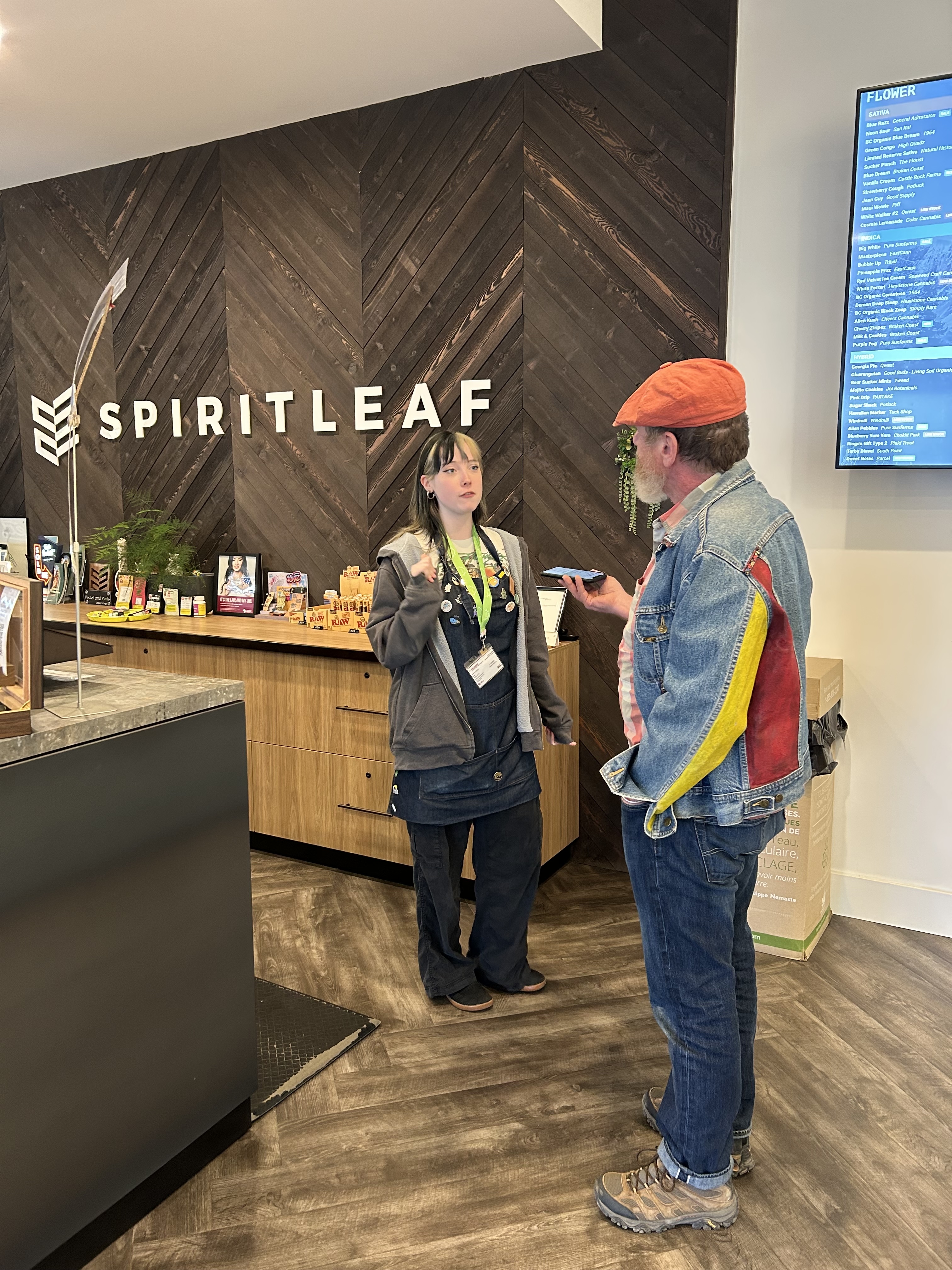
Kirk: Beyond Hope. Yes, this, well, first of all, Beyond Hope in Edmonton. I'm with my friend, Kala Knudslien, the cannabis nurse in Edmonton. And we've met her in the other episodes, which were part of this road trip. Kala took me to a few of her haunts. We went thrift shopping, shopping, and we went to Spiritleaf in Sherwood Park and we met a young bartender there. Now, the interesting thing about this story, Trevor, is that if listeners have been listening closely, they'll they'll hear this shop name dropped in the Veteran's show with Natalie and Rob. And hear it name drop it in the New Life episode as well. So Kala and her crew obviously respect this shop immensely. So this is me going in and talking to a young bud tender.
Let's listen to his Kamryn.
Kamryn: My name is Kamryn. My cannabis story, I was a really good kid. I didn't touch cannabis. I graduated when I was 17 and I did edibles like twice, like five milligrams, whatever. I didn't smoke my first joint until I was actually working on the coastal gas link pipeline. I was 18, but in BC you have to be 19 to smoke, but I had a co-worker of mine who got BC weed and he rolled me a joint. He said, here's your first joint. And I've, like joints have been my favorite, favorite way of consuming ever since. But I tried to consume very little but once I got out of that industry into the cannabis industry that's where I really fell in love with it. I am such a huge nerd about cannabis. I love learning about the terpenes. I actually my next step is learning how to grow it. I got us a grow-op tour at Partake pretty soon to go there so I'm really excited about that.
Kirk: How long have you been a bud tender?
Kamryn: Over a year now. I just passed my year here at Spiritleaf in February. This was my first cannabis job. And I use cannabis recreationally myself, though I do use like CBG and CBD for like pain and anxiety, especially when I'm on my period, like those CBD creams or like the bath salts save my life. I'm a huge advocate for it for women, for like even like period pain or anything like that. CBD is a great way to get started or CBG like those other cannabinoids and eat like it's great for people who don't want to get high. Like I know athletes who come here for CBD to help with their joint pain and stuff. Like it's really cool to see that. I love seeing how it helps people and I love hearing other people's stories
Kirk: So as a budtender, what education has Spiritleaf given you?
Kamryn: Well, I had to learn a lot. I did not know much when I first started working here and my boss Nikki was like, you are going to sit at this computer for a half hour and do your own research into terpenes. And she's like, I want you to go home and do it as well. And at first I was like, ah, homework, whatever. I was, ah. But once I started actually looking into the other cannabinoids and legacy strains and things like that, it just kind of snowballed from there. I just kept reading stuff about it. I loved talking about it or introducing it to new people who haven't had it before or didn't know what it was. Um, and then yeah, I just became a big nerd after that ever since she was like do your research I was like, okay And then I just never stopped and again, I hit a bit of a roadblock at growing I did try to grow some CBG seeds, but the mold got in. But so I'm like I really actually do want to learn how to grow it for real because that's the one thing when people come in and they ask about it. I'm like, I actually don't really know. Everything else I'm pretty well versed in and you know I try to as a budtender try to try everything whether it be the inhaler or the creams or the capsules the oils joints anything I try.
Kirk: Try everything.
Kamryn: Try everything.
Kirk: Yeah.
Kamryn: Yeah, even if it's not something like, you know, if we get a new drink in, you know.
Kirk: So does the Spiritleaf give you any sort of a con-ed or like do you know about the endocannabinoid system? Do you know about?
Kamryn: Yes.
Kirk: So does Spiritleaf help you with that?
Kamryn: Absolutely. Niki and Nick provided me with many online articles they sent me, many books, many things to read. We're really big about education here. So it was something, it was definitely like a must learn, but turned into more of a passion for me. But definitely they were like, learn about all the concentrates, learn how they make those, learn about the endocannabinoid system, learn the entourage effect. Like all of that I did have learned and they did give me the resources to learn with, like with, which...
Kirk: That's it. Thank you for the story.
Kirk: I just want to geek out a little bit about about meeting Cameron and geek out in the sense of using another part of my brain is my education degree. I have a post degree diploma in adult education. And it's been a fair bit of my my my career in an educational world. This girl just just gleaned with adult learning. For those people that understand the theories of adult learning, here we have an adult, a young adult who has discovered something that she's extremely interested in and she's going out diving into the literature and learning and it's one of the first rules of adult learning is that adults learn when they're really interested in something. The other thing I liked about what she was doing is she applies experiential learning So she likes to learn by doing. And so she goes out there and she says she tries all the products that come in. So the creams, the inhalers, the vapors. So she's out there learning by doing. And for me, my little educator's hat just geeked out going, wow, look, this is adult learning. And I find this in a lot of the visits I make with young bud tenders. And as we learn more and more about bud tender, they truly know a lot about the plant and they know a lot about cannabis, unfortunately, what they don't know a lot about is how it relates to the body, hence why they're not allowed to promote cannabis. But anyways, I just wanted to geek out a little bit about a young adult learning about cannabis.
Trevor: Absolutely and just and teachers you can all send your hate mail to Kirk or me but that is supposed.
Kirk: Why would there be hate mail?
Trevor: No no listening listening that the hate stuff isn't coming now. This is one of the reasons why proponents of AI have said why AI is so much better than a human teacher is because you know when you're interested in something you can learn about it like now you don't have to go through you know six months of learning about something you don't, aren't that interested in and hope you remember by the time you run into something you are interested in. But, you know, I guess the jury is still out about whether or not how good of a teacher AIs are going to be.
Kirk: Boy, this is a rabbit hole I'd love to get down in pedagogical versus
ang andragogical styles of learning, which actually segues nicely here, Trevor, to our web page.
Trevor: Well, it does. We have one of those.
Kirk: We have a web page reefermed.ca. And it's built for all types of learners. Like for those people that are interested in visualizing and reading they can see the transcripts for those people that like to see things they can watch the videos and those that are listening can listen so yeah anyways I was geeking out on on Kamryn and I apologize for that but I like I really
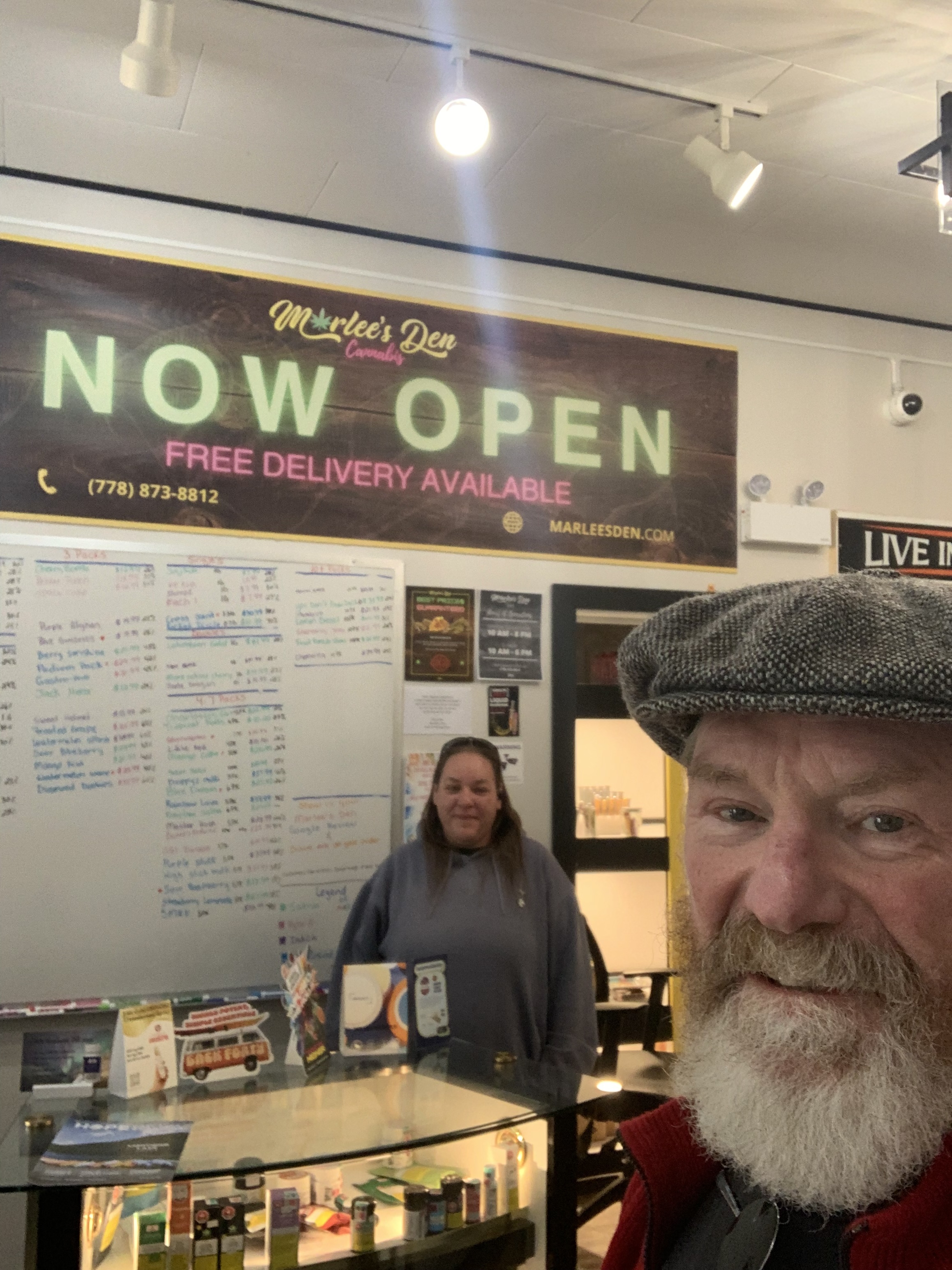
Trevor: Kamryn, but now I stepped on the surprise. We're going to listen to an old friend of the podcast. She has been on it before. You were in Hope talking to Lorraine at Marlee's Den.
Kirk: Yes, we first met her in Episode 131, Road Stories 2024, the last time I went through Hope. And you know, I forgot that trip I carried a bunch of posters and I was handing posters out to everybody. I should get back into that habit. But one of our posters is still on the wall. And we met her on episode 132. And she gave me two stories, Trevor. And so let's listen to them. Okay. So I'm back at Marlee's den and visiting Lorraine. So hi again.
Lorraine: Hi!
Kirk: What's happening in the rec market? What's going on in Hope?
Lorraine: I mean, I think everybody's just trying to recoup from the strike last year. There was no sale of cannabis, no sale, of alcohol, nothing. You couldn't order anything. I mean we didn't. We had some direct delivery options, but even with direct delivery, there's so much red tape that you can't get half of what you normally would.
Kirk: Okay.
Lorraine: So with government regulation, if they say. That the company is only allowed to have 20 plants. If they have more than 20 plants, they can't sell direct delivery. It means that all of their product for all of their brands has to go through the government.
Kirk: Okay.
Lorraine: Right. But so if they say that you had 19 plants, right, then you could sell directly to cannabis stores. But again, for so many of them that's not one brand. So you have a mother corporation, let's use DEALR as an example, DEALR is the mother corporation. Under the DEALR brand, you have BC Doobies, you BC Smalls, BC Quarter, BC Half, BC Ounce on top of the actual DEALR brand products. So it's like BC Smalls is one. BC Quarter is another, BC Half is another section under the same mother corporation. So it's like saying that you have one rep that deals with Spinach, that deals with Box saw, that deal with General Admission. So all three of those products fall under that one rep.
Kirk: Okay.
Lorraine: Right, so even though it's three different brand names, if all three of them, as an example, had 19 plants, you still can't do anything because it's the same mother corporation. So I grow a pot, the government approves the SKU for that pot, I send it to their warehouse because that's the only way I can sell it, is through their warehouse.
Kirk: Okay, got it
Lorraine: And then the government puts it on and then we as the cannabis shops buy it just said so we have Save On Foods was it Loba, Super Stores Save On Foods and Fresh Co. Right? They're all under the same corporation under the Laba Organization. Right so that them as growers as you know the people are trying to get their stuff into market, you get penalized, you get too big that if something like that, a strike happens, you can't sell any product.
Kirk: Oh, right, okay.
Lorraine: You have to sit on your product. You cannot sell it. You can't do anything with it until the strike is over. Right? So they don't like all of their stuff that's I mean, of course, as a grower, you're not waiting around to see what happens. You're constantly growing your constant reducing. Yeah, any other industry you constantly have to produce to keep up with it, right? So I mean they end up sitting on a bunch of their products and stuff like that. Whether it's flower, pre rolls, drinks, concentrate. Doesn't matter. They end up setting on it because they can't sell it. We can't buy it. While the government sits there and goes, well we're gonna decide what we're going to do. Whether it's because the employees strike, again. They're union, right? So, I mean, it is what it is. Everybody wants fair wages and everything else.
Kirk: Okay.
Lorraine: But then if you get a smaller or like a smaller company such as like Valhalla Flower as an example, they fall underneath that line. So for us, because we're licensed, we can purchase directly from them. They would ship directly to us as indirect delivery. But so we're a small store. Now let's say you have a bigger store. I don't want to name names or anything like that, but you have a bigger corporate type store. Right? Well, when all of this was happening, so smaller stores like us, right, we're gonna try and buy, you know, two or three cases of this or that from the direct delivery. Well, you have some of the bigger corporate stores that were going and buying a hundred cases of each SKU. So when they only released a hundred and twenty cases as an example, right before you even get a chance to get in there, it's gone. Right, the one morning they were supposed to, one of the direct deliveries, was supposed to do a release of new product. At 8 a.m, they did the release at 7:45. By 8:10 they were completely sold out of everything. And in talking to the rep like well what can we do right because i mean like we're there first thing like we are trying but just as quick as you're adding things and you're trying to go through the sold out sold out and even they said unfortunately there are some people that as soon as it became available they bought a hundred cases of this or a hundred cases of that which just wiped us out right. Again if you're a bigger corporate store You're not necessarily just buying for one location. You have multiple locations and you want to make sure all your stores have. I get it, but at the same time, because there's no limit, that means a lot of businesses closed. A lot cannabis stores permanently closed, thankfully we weren't one of them. But I mean, it affected us in many ways, it effected the cannabis industry in many ways. And that's part of it, like I get that they're trying to regulate and keep people quote-unquote safe. But I mean at the same time how many people have overdosed from consuming cannabis?
Kirk: Yeah, yeah.
Lorraine: Right? If you consume more than what your body can handle, you go to sleep and you sleep it off, or as some people say, you Green Out, which means you may get sick to your stomach, and then you want to go to asleep. There's no pumping your stomach. There is no, you know, having to pump through your blood because you like alcohol poisoning, blood poisoning, I mean, literally just want to go to sleep.
Kirk: I'd like to talk more about the BC Business, if I could. In the BC business, now you're not an LP, but you can buy directly from an LP a grower, right? So give me an example of what would be a local grower that you're buying from. I heard you talk to the last customer that one of these was a local grower. There was a bunch of them.
Lorraine: Yeah so we got um the BC Doobies which falls under the DEALR brand.
Kirk: Okay.
Lorraine: Right um BC Dubies the BC Smalls all of those they are local they're organic um and that is a bunch of our local growers that we're trying to get there for like they've been growing 20, 30 years sure
Kirk: Sure, the legacy market.
Lorraine: Long before cannabis was legal and you know part of legislation taking so long was so a lot of these local growers to get their foot in the door, to be able to get some of their product out into the market before the big corporate guys came along and went in. Well, there was so much red tape and so much stuff that so many of them didn't get a chance to even get their foot in the door or even close to it.
Kirk: Right.
Lorraine: Before it government took over and corporate and all of that. So a lot of them got together under the mother corporation DEALR. And DEALR, like I said, it's a lot of our local growers from here in BC that are about quality of the flower. The quality of what they're producing versus being mass produced and stuff like that. Mass produce works too, don't get me wrong, but so many people, they come to BC because want BC weed. They want something local and I think it's a great option.
Kirk: So they must have, so the strike must have helped them.
Lorraine: And in some ways it does, in some ways it helps a lot of the smaller guys.
Kirk: Yeah,.
Lorraine: Right. But I mean, yeah, it's. Two sides, right? They're still able to get their product out, which is great for them many ways when you think about it. They're the little guy so I'm not saying it's the case. But they're more likely to be living paycheck to paycheck like we are versus that corporate boss sitting in an office. It's like yeah, whatever. We were good for another one I'm, not saying they're like that. I'm sure they make great money doing what they do and they love it but they're more likely to be that so the fact that they can still sell the product is absolutely amazing. They're not gonna have that cut in their income they're not going to have that in their production.
Kirk: Right, right.
Lorraine: Right? Again, if you're corporate, it sounds kind of mean, but you have more money to play with.
Kirk: Yeah, yeah, yeah.
Lorraine: More money to throw at a problem and, oh, it's not that big of a deal. We'll pick it up next year. We'll break it off on our taxes.
Trevor: So I really liked to talk about the strike not that strikes are good you know in general during strikes people are unhappy but why this was interesting is a few episodes ago we were talking with Rob Raposo at New Life Cana and he was describing the BC strike from a grower's point of view. About you know how difficult it was to get cannabis into BC and you know how he felt like he was kind of accidentally screwing over one store versus another because you know, that's just kind of how it was going. It was interesting to listen from Lorraine's point of view, what this strike was like from Cannabis Shop's point view and it sucked. You know, they couldn't get stuff. They're quote unquote usual ways to get everything from the government warehouse, but there was none of that. Now they do have direct, you can send under certain conditions, I'm not an expert in this, but a grower can send something directly to a store, but there's a lot of rules about who can do that and how they can do it. And it's sort of intended to be my understanding from this thing with Lorraine is for small growers, so under X number of plants, you can do a direct shipment during the strike. But if you had more plants than that, it, you couldn't do it and weirdly even if you had an umbrella so it sounded like back in the day there was you know half dozen different uh individual cannabis growers and they sort of merged together under one umbrella organization and even if all those individual growers were under the magic number of plants that they could normally ship directly to uh to a store somehow under this the BC strike rules because they had an umbrella organization now, they're over the number of plants. Anyway, it was not surprising with all strikes. It wasn't good for the cannabis shops, it wasn't for the people who wanted to buy cannabis and it wasn't really good for growers and you know, mass confusion everywhere for a while.
Kirk: Yeah, thanks for giving that summary ahead of that because I found that a very confusing discussion I had with her at the time because it was new knowledge for me and now that we've had these other conversations, her comments make more sense. Now at the end of that discussion, we started talking some more and we got into the whole SKU conversation. So this is Lorraine again talking about skews but you wanted to make a comment about skews. SKU.
Trevor: S-K-U, Stock Keeping. Unit. I just want to say that properly once.
Kirk: So this was when we first started learning about how government treats SKUs in cannabis. Okay, so Lorraine, you were just telling me that the BC government will stop successful SKUs of cannabis. And the example you used was, if you have a, which, which example, the infused...
Lorraine: Yeah, so if you have, it doesn't matter what it is, if it's a concentrate, if it's flower, if its a pre-roll, infuse, anything. I've spoken to multiple reps about this, everything, and it doesn’t matter how successful a product is doing. After it's been available on the market for X amount of time, I don't know what that time frame is, I don't know if it changes for different products or what but after an X amount of time then they're no longer allowed to sell it. The government says that's enough. You either you need to remove it. You can replace it with something or not. That's up to you. So a lot of times customers find products that they like whether it's an infused pre-roll and oil Hash anything and then all of a sudden they go looking for it can't find it anymore and it's because the government has said enough of that they want something else brought in. And again it doesn't matter how successful it is or how good it's doing.
Kirk: And this happens all the time.
Lorraine: All the time.
Kirk: So so is it like give me an example of one SKU that's been around a long time like like are you I'm looking at a bunch of cannabis products here. So are you saying that like every six months or so one of these could be just they can just stop distributing?
Lorraine: And then yeah, lots of them, lots of them.
Kirk: That just doesn't seem efficient.
Lorraine: I don't know if it's just because there's so much product and I mean you got to figure every every grower is going to be submitting how many requests to have new product, new this. So I don't know if its just about trying to make sure that everybody has a regulated time. So I'll use General Admissions as an example. General Admissions used to have a pre-roll called Tiger Blood that was distillate infused, distillate and keif infused, okay? They got told they had to get rid of it. So what they did is they kept the Tiger Blood strain but now it's liquid diamond infused. So they changed the concentrate on it, so they were allowed to keep the SKU, like it's a new SKU number, but they were allowed to keep that Tiger Blood strain.
Kirk: Okay, but the government time to get rid of that because it had distillate in it.
Lorraine: No, it was just because it had been on the market for X amount of time.
Kirk: It'd be on the market too long, and they said, we're done.
Lorraine: Yeah, so the original was distillate. The new one is Liquid Diamond. So because they changed the concentrate, they were able to keep the Tiger Blood name, but they had to get a new SKU because it's now a new concentrate.
Kirk: But me as a customer, I can't form a favorite.
Lorraine: Well, and that's just it. I've had customers that use General Admissions, again, as an example. They love the Huckleberry flavor. They love that Glitter Bomb flavor. And within a couple of months, completely gone.
Kirk: And these are the infused reefers?
Lorraine: These are the infused ones.
Kirk: Okay.
Lorraine: There was a company called Tasty's. Phenomenal infused pre-rolls. Their peach infused tasted just like peach nerds in smokable form. Peach nerd, right? They were on the market for too long, so they're no longer available. They're no longer making them, and they were one of the best tasting pre-rolls that were out there for the flavor.
Kirk: Does this happen to flower as well?
Lorraine: Yeah. It happens across all of it. Flower, pre-rolls, infused. It's just General Admissions. More people know a lot of their names, like their brand names, so that, you know, yeah, I used to get Huckleberry and I can't now. That explains why.
Kirk: But okay, so but this would only happen at the warehouse this doesn't happen at the craft level. So the craft guys are able to keep their their and the craft guy's have SKUs as well?
Lorraine: Yeah.
Kirk: Okay, so the craft guys are keeping their mother plants going. It's the big guys that have to have to change a name.
Lorraine: Well, so even the craft guys say they were growing Northern Lights, and we're going to say the brand name was Craft. So after Craft finished growing, or they were going this Northern Lights after a certain amount of time, the government's going to say, okay, no more.
Kirk: So they're going to tell the craft guys too?
Lorraine: Yeah, no more. You need to do something else.
Kirk: You have to, you have to give us another varietal
Lorraine: Yeah because even if it's direct delivery even the craft guys still have to answer to the government still have, to go through the government tape and get government approval and everything. You cannot sell a single gram of weed in BC legally without government approval. The only difference is with reservation because their reservations have their own government rules and regulations compared to the rest of the stores, right? But so for all of us that are government regulated, right, it is what it is.
Kirk: Okay, so Trevor, so those are two stories. Again, a little different in the sense of who I'm talking to and where I'm talkin' to people. But again, it's just learning about how budtenders work within the industry. So another couple of stories that were cold calls.
Trevor: Yeah, it was great. We had, you know, Kamryn doing her own education of herself so she can serve her customers better. And then Lorraine getting us up to snuff on SKUs and strikes and all the other sort of problematic things that you run into if you're trying to sell cannabis legally in Canada.
Kirk: Yeah, all of these links will be on our web page, reefermed.ca. I'm Kirk Nyquist, I'm a registered nurse.
Trevor: I'm Trevor Shewfelt, I'm the pharmacist.
Kirk: And come back here there's going to be a part three for these road stories so see you soon Trevor.
Trevor: Another good one. We'll talk to everyone later.