Can cannabinoids change the future of concussion care in contact sports? Kirk follows up with Patrick Neary, PhD, from the University of Regina, to see how his NFL-funded research into CBD, concussions, pain management, and athlete health is going now that the study has moved from planning to execution. Recorded on 420, let's dive in: can CBD help reduce concussion risk, support brain recovery, and offer athletes an alternative to opioids? Dr. Neary explains the first phase of his research: a CBD dose-escalation safety study in athletes, including very high daily doses, brain blood-flow testing, cardiovascular monitoring, pharmacokinetics, biomarkers, and side-effect tracking. The episode also previews two related studies: a double-blind placebo-controlled concussion study and an upcoming pain study comparing THC, CBD, full-spectrum cannabinoids, and placebo. Listen now to learn how a multidisciplinary Canadian research team is studying cannabis, neuroprotection, inflammation, chronic pain, and the future of sports medicine.
E180 - 1 - The NFL’s Cannabis Study - Patrick Neary PhD
Meet our guest
Patrick Neary PhD
Research Links
- An Evidence-Based Objective Study Protocol for Evaluating Cardiovascular and Cerebrovascular Indices Following Concussion: The Neary Protocol
- Cannabinoid Therapy in Athletics: A Review of Current Cannabis Research to Evaluate Potential Real-World Cannabinoid Applications in Sport
- Considering the Effects of Cannabinoids and Exercise on the Brain: A Narrative Review
- NFL Awards $1 Million to Study Impact of Cannabis and CBD on Pain Management
- NFL awards $500,000 for Canadian university to study cannabis as a concussion treatment
Music By
Desiree Dorion
Marc Clement
(Yes we have a SOCAN membership to use these songs all legal and proper like)
Episode Transcript
Trevor: Kirk, we're back.
Kirk: Hey, Trevor, how's it going, man?
Trevor: Good. If I have this right, I think you literally recorded this on 420.
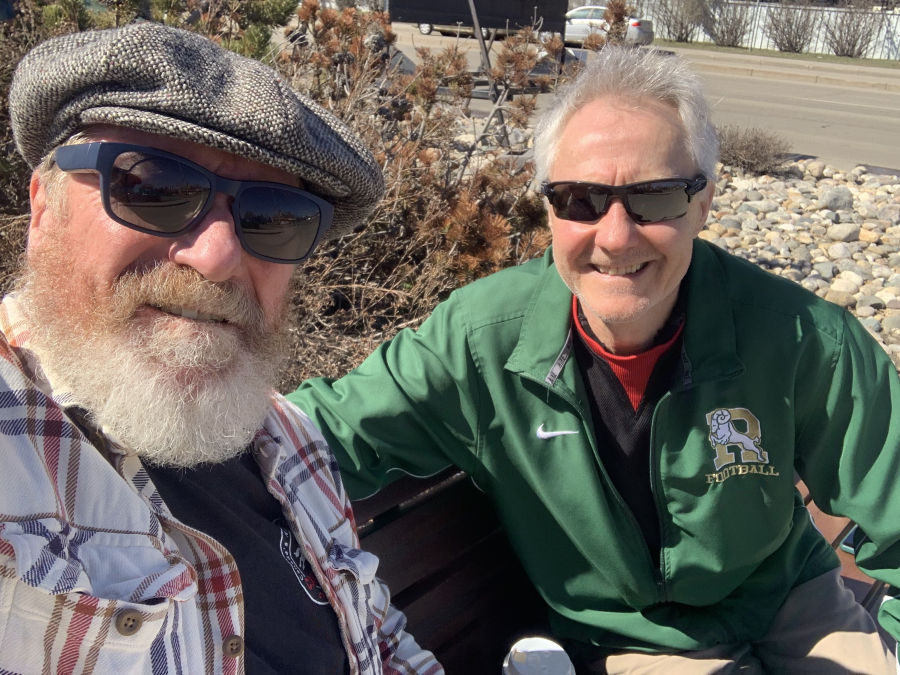
Kirk: Yes, this was recorded on 420. I was sitting in, well, Dr. Patrick Neary, PhD. He is the Faculty of Kinesiology, Health and Science, University of Regina, and we were on campus. We're sitting on the corner of Kramer Boulevard and Wiscana Parkway. There are students going back and forth. There's cars going back forth, you can hear breaks. Can hear cars. So it's Theater of the Mind. We're sitting on a park bench talking about cannabis and concussions.
Trevor: Okay, and before we get any farther, because half the time we're remembering to do this, I'm Trevor Shewfelt, I'm the pharmacist, you are.
Kirk: Oh, I'm Kirk Nyquist, I'm the registered nurse and you're listening to Reefer Medness, The podcast, found at ReeferMed.ca. And today we're talking about researchers that are into using cannabinoids for concussions. And it all starts with the NFL. And the ultimate goal is the National Football League in America. They want their athletes off opiates. And they wanted to start a study. And they picked two out of what, two out of a hundred studies in one?
Trevor: 106, my notes say.
Kirk: Yeah, yeah, and one's Canadian. And as you hear this conversation, Dr. Neary really goes deep into how many multidisciplinary people are on his team.
Trevor: Yeah and so before we're going to let him talk you see he does this better than us but just I think it's good for people here up front there's sort of three different studies that Kirk and Dr Neary are talking about. So, study one which is basically finished and the paper is about to be published is basically what we call safety study. They gave them big doses of CBD to see what athletes could tolerate. Study two we're kind of in the middle of this is the actual concussion study, mostly football players. For half the year, it's double blind placebo control, they don't know what you're getting, but for half of the year they're getting a cannabinoid capsule and for half a year they are getting a placebo and then the second half of football season they're switched to whatever they didn't have and they're doing that for two seasons. Last season the season coming up. And then number three, the upcoming one will be a pain study called the Latin Square Design, former and current athletes. They'll be randomly assigned a THC, a CBD, or full spectrum capsule or placebo. So one of four, and then you'll take your capsule for a month, have a two week wash out, then you will be on to another one, then another one and another one four times, and it will be random. You won't know which one you're on and which time. And that is looking at pain; neuropathy and otherwise. Those are just real short, but just so, because it was a great conversation, But just so people have those in their minds, we have. The safety study, the concussion study, and the pain study is study one, two, and three.
Kirk: And like you said we're in we're on 420, 2026 on the campus of the University of Regina. So please Dr. Neary introduce yourself and let's uh let's talk about your study and and maybe maybe remind us where we were at we were I think you were just submitting your study You just got your funding.
Patrick Neary PhD: Yeah, we've marched forward. We've been very successful in completing two clinical trial applications to Health Canada, and they're arduous. It takes a lot of work to put a clinical trial application together, and then, of course, get it approved by Health Canada. So we're very successful with the very first one. And our first one, again, was to look at dose escalation. How much CBD and only CBD in an isolate form, can athletes actually take safely? And the whole idea is we ramp them up from five milligrams of CBD per kg of body mass, all the way up to 30 milligrams per kg a body mass. So, Kirk, some of these guys took as much as 4,000 milligrams in a day.
Kirk: Now this is ingesting, right?
Patrick Neary PhD: Yes, yeah.
Kirk: Is it ointments, or sorry, tinctures? Or is it capsules? No, it's...
Patrick Neary PhD: No, it's an isolate that we had them put into a fruit smoothie in the morning.
Kirk: Wow.
Patrick Neary PhD: Yeah.
Kirk: They're big boys.
Patrick Neary PhD: Yeah. Oh yeah, they were big boys and so I think one was about 140 kgs and he was the one that had more than 4,000 milligrams a day for two weeks. So that's what the dose escalation was. Every two weeks, they would come back to the lab, they'd have our physiological testing to look at, you know, brain function, you know. We're using a transcranial dauber to look at blood flow, near-infrared spectroscopy to look at brain oxygenation. We had blood pressure responses. We took bloods to look at what the pharmacokinetics was, and then we would put them on their new dose. They would come back and then we would assess them again.
Kirk: So when you're talking about dosing, so my understanding of CBD is it can really harm the liver, so you're actually going, you're going deeper, so as you, as you give them a dose, you are going through the assessment for every layer of dosing.
Patrick Neary PhD: Correct.
Kirk: Cool. Okay, cool.
Patrick Neary PhD: Yeah, and certainly right now, what now is we're crunching the actual data, specifically the bloods. And that's the biggest thing that we've been waiting on. And it just takes so long to do the analyzes, right?
Kirk: So what are you looking for in the blood when you're doing the blood analysis?
Patrick Neary PhD: So we're looking at CBD and its metabolites. Six, seven, oxy six, seven the carboxy as well. So there's three or four of the metabolites that we're actually looking at.
Kirk: Okay.
Patrick Neary PhD: In addition to CBD.
Kirk: But you're also doing a CBC and checking if it's affecting the red blood cells or white immune system. Are you doing any of that?
Patrick Neary PhD: We do have biomarkers, we're looking at immune function, interleukin 10 as an example, we are looking at BDNF for the brain, so we got a variety of different biomarker that we are looking that are immune function.
Kirk: Okay, and are you able to actually check the endocannabinoids? Can you actually check people's anandamide levels or?
Patrick Neary PhD: We haven't.
Kirk: Okay.
Patrick Neary PhD: Now we haven't we've just looked at what the amount of CBD that was actually taken in with each of this.
Kirk: Okay, I'm sorry I interrupted.
Patrick Neary PhD: Yeah. Hey, no. No, I think it's really really important. Yeah, okay These questions come up. So so the whole the gist of that experiment we were able to show that CBD does not have a negative effect on Cerebrovascular and cardiovascular function. Even at those high doses. Amazing. And again, the main reason is of course, your endocannabinoid system is stimulated, augmented when there's stress in the system, right, so they took this at a time over the summer period when they were simply doing their workouts, they were working, right, it was after School time,.
Kirk: So they were not working as football players. They were not training. They were off season, playing golf.
Patrick Neary PhD: They were offseason playing golf, but they were still, you know, doing some activity.
Kirk: Well, they have to. Did you check liver enzymes at all? Was that part opf your check.
Patrick Neary PhD: No, we didn't check specifically the liver enzymes, but we did have a hepatic panel at different stages, all right? So we didn't look at them all, but did have the hepatic panels after the very first, after 15 and after 30, just to make sure that we were all 30 milligrams. Oh, man. Okay, so five milligrams after 15 milligrams per kg. And then at 30 yeah and we just followed them just to make sure they were okay the biggest downside of it all and it only affected some of the athletes is the GI tract problems. You know gastrointestinal mostly diarrhea okay okay yeah and so some of them did have diarrhea and so of course we looked into that further and as soon as they stopped well then everything went back to normal.
Kirk: So it's activated, so what does that tell you? Does that tell that the CBD is not absorbing water in the lower, in the large intestine?
Patrick Neary PhD: Yeah, yeah, it's just it's creating a discomfort for them and it's
Kirk: But physiology-wise, it's preventing, for some, it's going too deep. No, one thing that we may not have clarified are the individuals who've had concussions.
Patrick Neary PhD: Yeah, some of them have, but that wasn't necessarily a criteria because of course this was during the off-season, but we did record the individuals that did have a concussion, just to make sure that we've got that data set as well, we've go that information, sort of the demographics behind our population. But what we found really interesting is that some of the individuals were not affected whatsoever from a GI tract diarrhea perspective. And we bring that down to diet. And of course, as you know, CBD is lipophilic, all right? It needs lipids and fats in order to be taken into the system appropriately. And so we're beginning to think, you know that maybe some of the guys didn't have enough fat in their diet to allow for that absorption to actually occur.
Kirk: So that would refine your next assessment is to ask them about their diet. So they were kind of processed foods versus whole foods versus, okay, cool. So this is one study. Is this study part of the NFL study.
Patrick Neary PhD: It is.
Kirk: So how does it relate to the NFL studying?
Patrick Neary PhD: Yeah. So, so we wanted to do a dose escalation because there was so much information or lack of information in the literature to really show, you know, how much could athletes take or individuals take on safely? You know, what's the efficacy of, of using CBD? And of course, as you know it's, it's non-intoxicating.
Kirk: Right.
Patrick Neary PhD: Right. Non-psychoactive. Well, I guess it depends on how you define psychoactive. It does have a psychoactive property, but it's not intoxicating.
Kirk: It's not cerebro intoxicating.
Patrick Neary PhD: Yeah, well, so that's, so when you talk about, you know, not being a non-psychoactive, well what does psychoactive really mean? It's not necessarily negative or positive, it's just that the drug has an effect on the body. Right.
Kirk: Right.
Patrick Neary PhD: So I think in the literature we have to clarify that.
Kirk: That's a good point, because psychoactive, I guess when someone tells me that something's psychoactive I'm thinking more cerebral, that it's affected cerebral, but really it means more systemically, right? Exactly. It has effect. So what is the purpose? What is the thesis of this study? What's the purpose.
Patrick Neary PhD: Yeah so the whole focus of that one is again how much could we actually give athletes to take safely and then can we determine an optimal load of CBD that we can give them to potentially prevent concussions because we prevent the concussions yeah because or to mitigate to reduce them because we know that CBD and other cannabinoids are neuroprotective as well as we know they're anti-inflammatory.
Kirk: That's what I was gonna ask you. And so I was thinking it could also help with pain management, could it not?
Patrick Neary PhD: Yes, yeah. So, so we want to do that study first just to see whether or not we can get some sort of an optimal dose formulation, all right? So with that, and based on GI tract problems that some of the athletes had, we've come to the conclusion, and again, we still haven't published this, but we've got a bunch of papers that are ready to go out, but were just waiting for the blood to be analyzed, you know, the complete blood analysis. And so, we're thinking somewhere between... About probably 1,200 and 1,500 milligrams could be a potential optimal amount to avoid GI tract problems, all right, and then potentially provide this neuroprotection and anti-inflammatory effect.
Kirk: This is, this is fascinating. Where did you... Where did this all, like, what made you think to do this? Like, remind us if we didn't ask you that. What made you thing that, hey, let's approach the NFL to say that we can help athletes with cannabinoid?
Patrick Neary PhD: Yeah, and that's why I mentioned Elizabeth Thompson's name, because Elizabeth, my co-supervisor for her PhD with another professor at the University of Saskatchewan. Jane Alcorn, and she's in pharmacy. She's our pharmacokineticist. Elizabeth calls me up one day and she says, Neary, guess what? The NFL is giving out money to look at cannabinoids, medical cannabis, for concussion and pain management. And potentially to get their athletes off of opioids, right? And I thought, absolutely not. I don't believe it, I don't believe that they are. Sure enough, she sends me the link and I said, you know, what the hell, let's apply. So what I did was I put together this team because I know that any research that we do, you cannot isolate the brain or the heart or the lungs or the muscle.
Kirk: Sure.
Patrick Neary PhD: All right. Or the immune system, right? You gotta include everybody. So I decided to go out, and I've worked with a variety of academics and professionals and medical doctors, including a pediatric neurologist, who's on our grant, a sports psychologist, we've got a cardiologist, we've a graduate students, of course, a pharmacokineticist, as I mentioned, a biostatistician. All right, an exercise physiologist.
Kirk: And you call all these guys. Hey, I got this idea. And they're going, what the hell, man? What have you been smoking?
Patrick Neary PhD: Yeah, yeah, yeah. That's what they were saying. Neary, have you been smoking?" And I said, no, I haven't. So then, of course, when we applied, the NFL came back to me and they said, you know, why should we fund you? All right, because so Kirk, there were 106 applications submitted globally and we were one of two. All right. And they asked me, they said why should you fund you and I said well, if you want look at cannabinoids. And chronic pain management and concussion, you can't look at just the brain or just the back. I said, you got to look at the whole body. And that's why we've got, you know, the pharmacokineticist, we've gotta cardiologist, pediatric neurologist, you now, exercise physiologist, sports psychologist, a pain management specialist, all right? So we had everything.
Kirk: And multidisciplinary team.
Patrick Neary PhD: Exactly. So, you knowing, moving fast forward. We've done this first project to try and get an idea of how much we could actually give athletes safely and efficacy related so that we would be able to then hopefully prevent concussions in the future. And again, the reason why I go back to this is because I had the very, very good fortune of meeting Lester Grinspoon, Dr. Lester Grindspoon.
Kirk: I do know, yeah. We interviewed his son.
Patrick Neary PhD: Yeah and and unfortunately Lester has now left the planet yeah and and as I said I had the good fortune of meeting him in Boston back in about 2017 to 16, 17 after he had written an open letter to Roger Goodell the NFL Commissioner basically stating it's criminal that you're not allowing your NFL players to smoke pot because it's neuroprotective. And his whole goal in life, and he, of course, as you know, he's written a number of different books, you know? Medical marijuana books and the forbidden medicine, you know that sort of stuff. So one of the last things that he left with me is he said, I wanna be able to see our world where mom and dad say that Johnny and Sally. Take your endocannabinoids or your phytocannabinoids and go out and play.
Kirk: Yeah, Dr. Shelley Turner, I interviewed her, gosh, five, six, seven years ago, and one of the first things she said, Canadians, all Canadians should be taking vitamin D. And if any doctor doesn't prescribe vitamin D before they provide a psychotropic drug, they're not practicing medicine. And the other thing doctors, every Canadian should be taking is vitamin CBD. And it was like, I'd never heard that before. Vitamin CBD. And she said yeah, it's it's It's what everyone should be taking. So this is from Lester, probably.
Patrick Neary PhD: Yeah, so Lester had stated that and I thought, oh, what a, so I thought I can use the NFL, all right, and the funding to hopefully have this trickle-down effect. And again, when people ask me, and I've had phone calls from relatives and others, you know, my son has got a concussion or my daughter's got a contusion, what would you recommend? And I said, well, first, I'm not a medical doctor. Right. All right, so, I can't prescribe anything. And then I said, if it was my son or my daughter, I would be giving them high doses of CBD, potentially CBG and CBN, all right? These different.
Kirk: Yeah, yeah, I'm very familiar with it.
Patrick Neary PhD: So they said, really? And I said, yeah, if it was my daughter, those are all non-intoxicating. There's nothing in the literature to suggest that it will create any adverse effects.
Rene: Alright, that's where we're going to stop the conversation for today that Kirk had with Dr. Neary. I'm Rene, back here in the studio. Thanks a lot for listening to Reefer Madness, the podcast. Make sure to keep your eyes open for part two of this fascinating conversation.